A Small Surprise on a Big Buffalo

Kapama Ranger Blog

A Small Surprise on a Big Buffalo

Dec 5, 20174 comments

We left the Kapama Buffalo Camp around 6:00am in the morning. As we approach summer time our program changes so we leave slightly earlier in the mornings so we can catch the best sunrises and animal activity. You could already feel the crisp early morning bite was slowly subsidding into a pleasant freshness that only the change in season can bring.

We were only about a week away from summer and the Impala lambs were already dropping. As I was sipping away on some cold water, I knew this is exactly what the herbivores must be doing now. When you see many animals passing by the waterholes early in the morning, one must be prepared for a very warm day here in the South African bushveld.
It was the final half hour of our morning game drive. I decided to go past three dams, each slightly north from the other, almost in a straight line. These dams are surrounded by deep drainage lines covered by Tamboti and Jackalberry trees, as well as the odd Guarri Bush. We had been blessed in the past here by numerous Big 5 sightings, including regular leopard sightings of a resident female and her cub that has since been seen enjoying her own company as she looks for new territory for herself.

On this particular morning the first two dams were only accompanied by an impala bachelor herd, a warthog or two and a small herd of kudus. As we approached the third and I turned off the engine, the silence was broken by soft grunts of buffalo and the high pitches of the red-billed oxpeckers. We all sat for a moment to take in our scenery and appreciate the privilege of being surrounded by such beauty and wonder.

Our pleasant surroundings soon changed into an amazing sight.
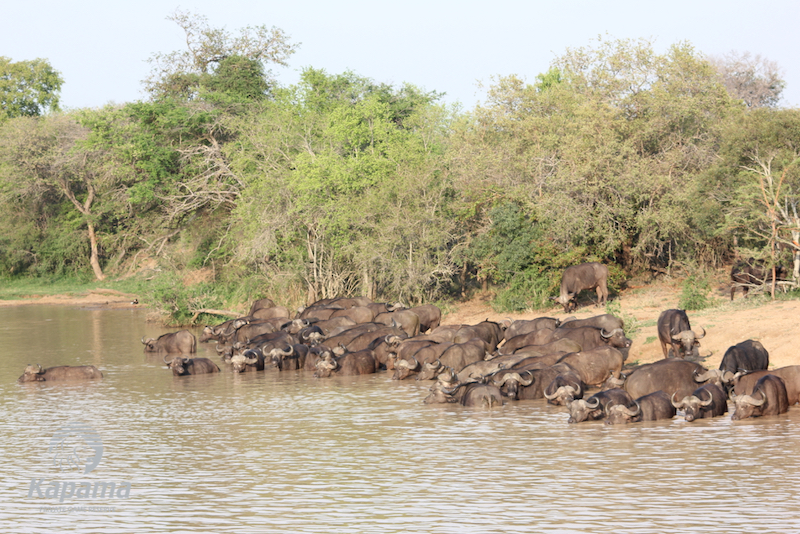
We watched in awe as around 150 Cape buffalo appeared out of the tree line and made their way down to the water’s edge. The group became louder as they pushed their way through to find an open place to drink. Many oxpeckers flew down to drink as well.

After quenching their thirst the buffalo waded through the shallow section up towards us.

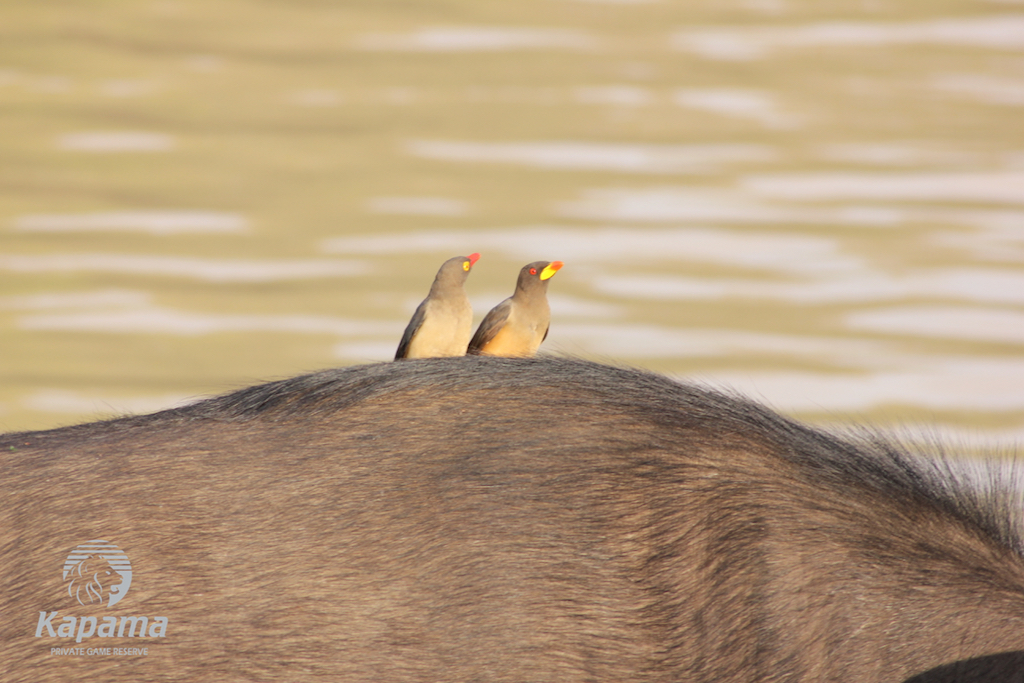
While scanning the area with my binoculars I noticed one oxpecker looked quite different from the rest, even the call wasn’t what I was used to. I immediately smiled as I realised that what I was looking at was a yellow-billed oxpecker!

This is a bird found in the area but far more rare than the regularly sighted red-billed oxpecker which is native to the Savanna of sub-Saharan Africa, and can be found just about anywhere that there are roaming grazing herds, from the Central African Republic to Sudan as well as all of South Africa.

So you can understand my utter exhiliration to have spotted a yellow-billed oxpecker.
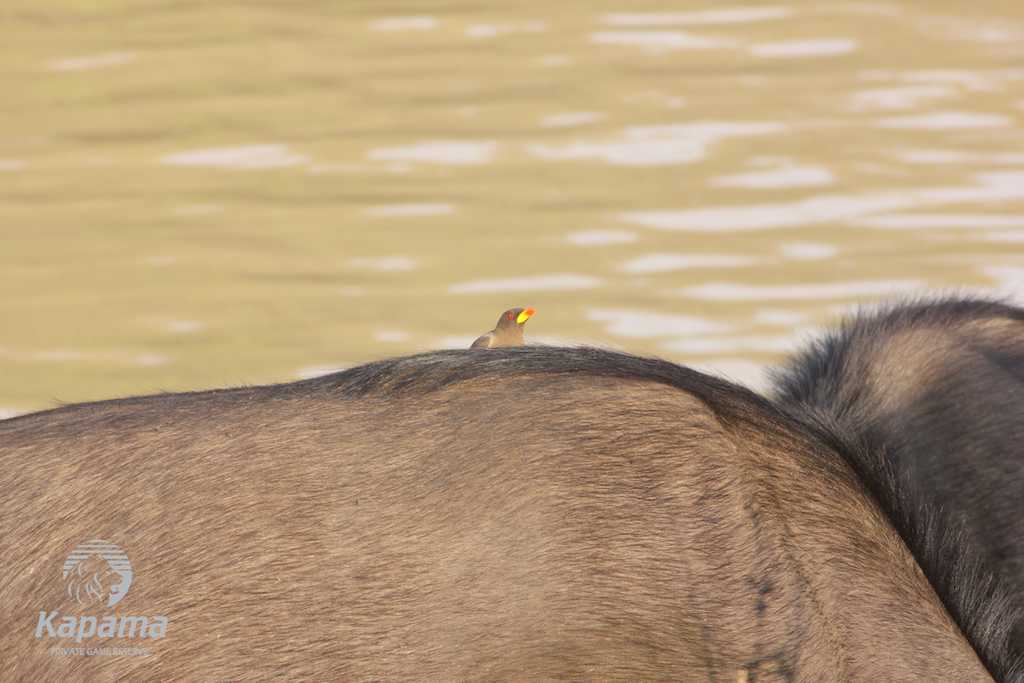
I was so excited I started snapping away with my camera while explaining to my guests that this was my first sighting on Kapama of this oxpecker. The eye of the Yellow-billed oxpecker is bright red and lacks the large yellow orbital ring of the Red-billed oxpecker. The final give away is as the name suggest, it has a yellow bill with red on the tip.

It is slightly more robust looking and also feeds on the ticks on large herbivores, especially buffalo.

The red-billed oxpecker uses scissoring motion to extract insects tangled in the long hairs, yet the yellow-billed oxpecker uses pecking motion to grab insects. Though they rid animals of pests, oxpeckers also take blood from the sores, which may be slow to heal.
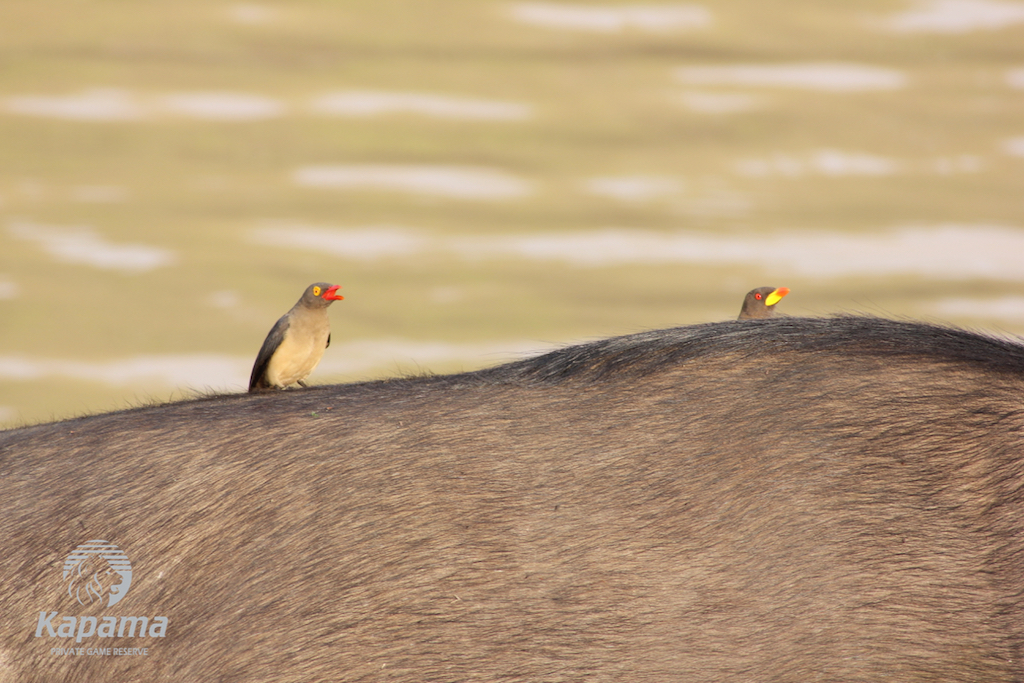
Some times it’s the small things that many will overlook, that are the real special sightings; you just need to know where to look.

Story and photos by: Monika Malewski – Buffalo Camp

Latest news

No Results Found

The page you requested could not be found. Try refining your search, or use the navigation above to locate the post.

Kapama Wahlberg Eagle

Signs of a South African Bushveld Summer

This is an exciting time of the year for us as the bush comes alive. Kapama Private Game Reserve is certainly a year-round destination, with winter offering terrific sightings of both animals and birds. However, summer brings in new and exciting aspects to a Safari.
Kapama Puff Adder Snake

The Moving Branch

I had been driving on a straight road when in the distance I spotted what looked like a thick branch lying in the middle of the road. I looked around, scanning the bush and terrain for other animals that would now be moving to find water. I looked back onto the road and this “branch” had somehow moved to the other side of the road.
Kapama leopard eating

Leopard Caught Feasting

Besides the Lion, the Leopard is the next biggest African cat, with an average mass of 60 to 70kg. The Leopard’s hunting technique is to either ambush or stalk its prey, in either instance it tries to get as close as possible to its target. It then makes a brief and explosive charge up to 60km/h, pouncing on the prey with a bite to the neck.

The Little Five and Smaller animals in Nature

I got so excited and immediately nodded in agreement. I knew I had a kindred spirit on the game vehicle, and that our time together would be something special.
Hmm… nothing matched your filters. Try changing your selection!