Endangered Big 6 Bird
It was our afternoon game drive. We set out from Kapama’s Buffalo Camp in search of some of the big hairy and scary animals of the bush – none other than the members of the BIG 5. I decided to take a route that would allow us to visit a couple of the watering holes in the area to see if we could spot some of the bigger animals possibly having a late drink in the hot afternoon sun. We came around the one corner of the dam wall of our first watering hole in the vicinity.
What a huge surprise!
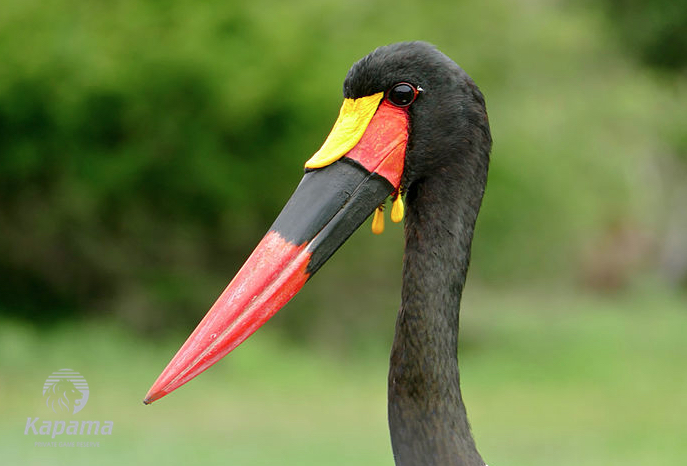
We had just stumbled upon one of South Africa’s most beautiful birds, which is also a member of the “BIG 6” Birds of South Africa. There they were, not one but two breathtakingly beautiful Saddle-billed Storks. Right before our eyes, a male and female saddle-billed stork casually strolled through the cool dam water, giving them a chance to cool off under the tough African sun.

The other 5 out of the 6 birds are:
- Martial Eagle
- Kori Bustard
- Lappet-faced Vulture
- Pel’s Fishing Owl
- Southern Ground Hornbill

I was super excited to see them and also surprised at how relaxed they were. I immediately grabbed my camera next to me and took a couple of pictures. By this time the guests could see how excited I was and asked me why I was so happy to see these birds. As I start talking about them a bit more my guests completely understood my excitement.
To see one of these magnificent birds is truly a breathtaking and memorable experience.
These birds can easily be identified by their black & white plumage and extremely long black legs with red in the centre of the legs. Also with the long colourful spear-like bill which consists of black and red with a yellow saddle at the base. Male saddle-billed storks have little yellow wattles (those fleshy caruncles that hang from various parts of the head or neck in several bird species) as well as a dark brownish eye. Whereas the female has a bright yellow eye. They are found in pairs, which is territorial, or alone close to a water source of any kind.
We spent some time with them watching them foraging in the water for a meal and striking in the water with every movement detected. They mainly eat fish but frogs, reptiles, smaller mammals and even birds form part of their diet. While we were watching them, one of the storks managed to catch a small little frog and swallowed it whole without any trouble. Soon they decided they had enough and moved to the edge of the water, stretching their wings and legs in the last daylight that was left. We left them there and continued with our drive.
The next morning my guests and I were curious to see if they would still be in the area so we returned to the same watering hole. I was incredibly pleased to see that they were right where we left them. One was busy strolling through the water in search of some breakfast while the other was trying to warm up and dry out from a wet evening on the edge.

This was truly an amazing sighting to come across because they are classified as endangered species in South Africa. The biggest danger these magnificent birds face and why they are becoming endangered is due to the damage that is being done to numerous wetlands as a result of urbanisation and development. As part of their normal habitat, saddle-billed storks require vast open spaces along bodies of water and wetlands in order to have easy access to their sources of food. The fact that they breed really slowly does also not help their cause either.
With an estimation of only 100 storks and 25-30 breeding pairs left, this makes them far rarer than a few other endangered mammal species such as the Wild dog, Cheetahs and even some of popular BIG 5.
I was incredibly pleased with our discovery, and that I could educate my guests on some of the other types of magnificent wildlife Kapama Game Reserve offers as part of the game viewing experience. My guests could take home another special memory of their time in South Africa.
Story and photos by: Hancho Olivier – Buffalo Camp
Latest news
No Results Found
The page you requested could not be found. Try refining your search, or use the navigation above to locate the post.