Lilac Breasted Roller
The Roller family; Coraciidae, gets its name from the acrobatic aerial displays that these birds perform during courtship and territorial displays.
In southern Africa there are five Roller species, and here at Kapama, in amongst our 350 bird species, we are lucky enough to get 4 of these, The Lilac-breasted Roller, the European Roller, the Purple Roller and the sort-after Broad-billed Roller. These are all equally beautiful birds, and luckily for us there are beautiful visual differences between them.
I’m going to focus on the lilac-breasted Roller. They are one of my many favourite birds because of their beautiful lilac patch on their breast and in flight they have unmistakable bright blue flight feathers. These birds in flight will make any birder or non-birding persons jaw drop. Both sexes look alike with the lilac-breasted Roller, they are the only species with a lilac throat patch and the distinctive bright blue belly and body.
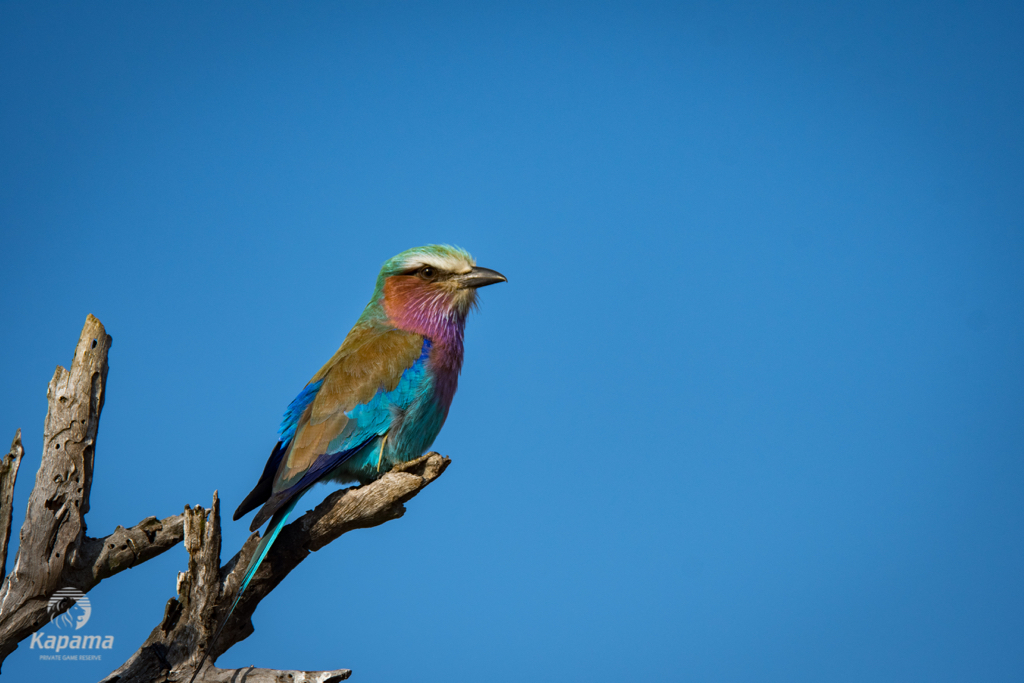
Both sexes look alike with the lilac-breasted Roller, they are the only species with a lilac throat patch and the distinctive bright blue belly and body.
Their name comes from their unique flight displays they perform. They will perform a fast, shallow dive from a considerable height with a rocking and rolling motion and a distinctive high-pitched vocalisation call. These displays are used to attract females for mating purposes as well as to defend territories and to chase threatening males away. These birds have been recorded to be monogamous, they have also been recorded to breed “on the wing” (in flight), so they mainly do these displays to advertise and defend territories.

Their feeding behaviour is also unique, in the fact they use a “sit-and-wait” technique, this basically means they sit on a perch and wait for an insect to fly by and then they will dart down and catch it. They then return to the perch to devour their meal. One other typical aspect of their feeding behaviour is to prey on insect and invertebrate species that are fleeing from bush fires.
These birds are commonly found in the Northern parts of Southern Africa, they are not threatened and will be found in open savanna plains and woodland areas

Recently, while out on a game drive with guests from Kapama River Lodge, we were lucky enough to witness a flight display from a male lilac-breasted Roller, right in front of our vehicle. He then came over and perched right next to the vehicle and posed for us. To date, that was my best bird sighting ever. The bird even left a memento for us, a flight feather. I have it safely kept in my collection, and every time I see it, it brings back very fond memories of the amazing flight display I witnessed.

Story by River Lodge Ranger Brian and photos by – Mike Brown
Latest news
No Results Found
The page you requested could not be found. Try refining your search, or use the navigation above to locate the post.