Seeing Spots
Of all the African animals, it seems the poor spotted Hyena has the worst reputation. Various films, like Disney’s The Lion King, and a place in the “Ugly 5” have only made this worse. One of the common defamations is that they are scavengers, stealing most of their food from more honourable species like Lions. Some claims have even been made that they dig up graves in search of human corpses. (Seriously inaccurate.) It’s high time someone stood up for these incredibly social and intelligent beings.
It was a beautiful autumn evening drive and my guests had been so fortunate to have already experienced the excitement of the big 5. I decided to test our luck one more time and take a drive past the currently active Hyena den on the reserve. Hyenas are predominantly nocturnal and so I timed it so that we would get there about half an hour after sunset when they would hopefully be gathered around the den.
About 30 metres from the den I switched off the engine and slowly rolled the game viewer down the sloping road so as not to frighten any potential cubs playing outside. I was so keen to show my guests these fascinating animals that I found myself holding my breath. Then suddenly out of the darkness a very large spotted Hyena appeared. I recognised her as the matriarch by a substantial tear in her right ear. We followed her down the road and were welcomed by the most magnificent sight; two young cubs (pups is also an acceptable term for young Hyena), one sub-adult, that I estimated to be between 6 and 10 months old as well as another adult female Hyena.
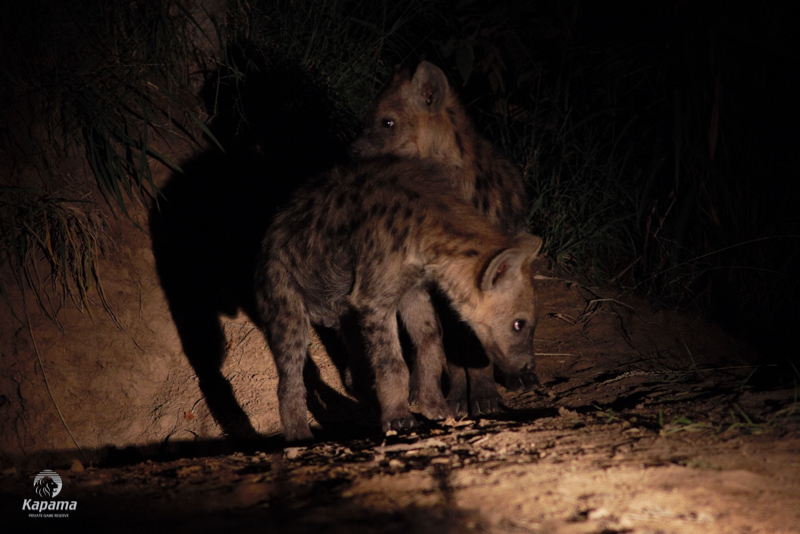
Hyena clan sizes vary considerably, ranging from just a few to over 130. The spotted Hyena have been found to have particularly enlarged forebrains, the region involved with complex decision making, as well as a vocal repertoire several times larger than that of other hyenas and even lions.
Each Hyena uses smells, sounds and visual clues to recognise other members of the clan and we watched in awe as the two tiny cubs bounded over to their mother, pushing each other to find a teat. They suckled for a minute or two with the mother still standing and then one went on to sniff and even lick the genital area of his/her mom.
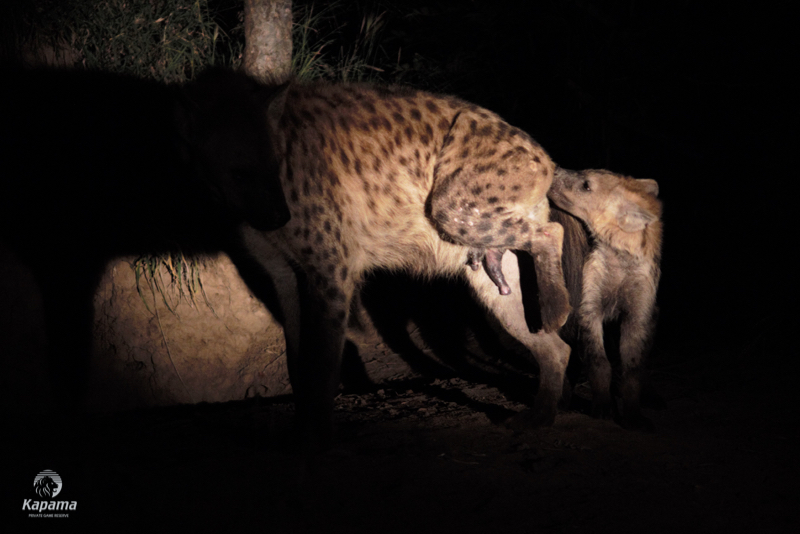
It is notoriously difficult to sex a hyena due to their reproductive anatomy. The female genitals are elongated to form a fully erectile pseudopenis through which they urinate, copulate and give birth. This is caused by unusually high levels of testosterone in the females, which dominate over the males with their size and aggression.

We watched as the females slowly left the den site, probably in search of food for the night. Spotted hyenas only scavenge 50% of all meals and are quite successful hunters, able to bring down prey the size of a fully grown Wildebeest.
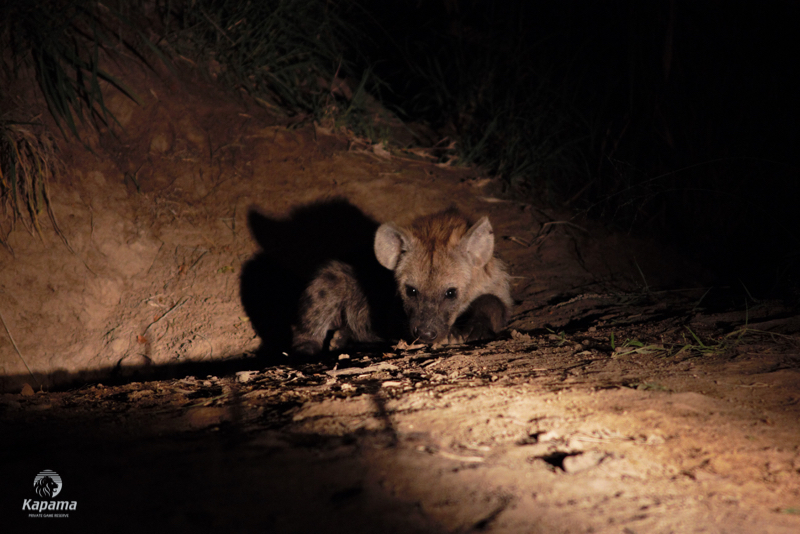
Having two growing cubs, she would need to make sure she feeds regularly to provide them with nutritious milk. The playful cubs remained instinctively at the den, rolling around and play fighting with one another. We felt so privileged to be able to view them in such intimate moments. It was obvious they were tiring, and one lay down to rest while the other snuck back into the safety of the den. We decided that it was time to head back to the lodge for another delicious dinner.
I looked back at my guests who were all smiling ear to ear, definitely satisfied with such a beautiful sighting and their perception of this poor misunderstood animal forever changed.
Story by Buffalo Camp Ranger Monika Malewski
Latest news
No Results Found
The page you requested could not be found. Try refining your search, or use the navigation above to locate the post.