Practice Makes Perfect
Finding lions on safari is always something that gets your heart racing. Not just because they are part of the Big 5, but because of their stature. All those great tales of power, strength and their majestic size. That overpowering feeling that you are so close to a creature that is able to take down something as mammoth as an African or Cape Buffalo can send chills down your spine. I guess they are not referred to as “Kind of the Jungle” – or bushveld for nothing.
For our guests, the Big 5 is always a high priority, but to come across young calves and or cubs is always something special.
So you can imagine my excitement when I found fresh tracks of a lioness with her two cubs on a recent safari. If you did not know, lion cubs have pretty large feet, which they slowly grow into. So because of this, I could tell that the impressions on the ground alluded to young cubs as well as an adult.
After following for a couple of minutes, the tracks took us to a small dam surrounded by reeds and some beautiful Fever trees. Lying in the shade of one of the trees on the edge of the dam we spotted the lioness, peacefully snoozing on this very warm winter’s afternoon.
I was wondering where the cubs might be.
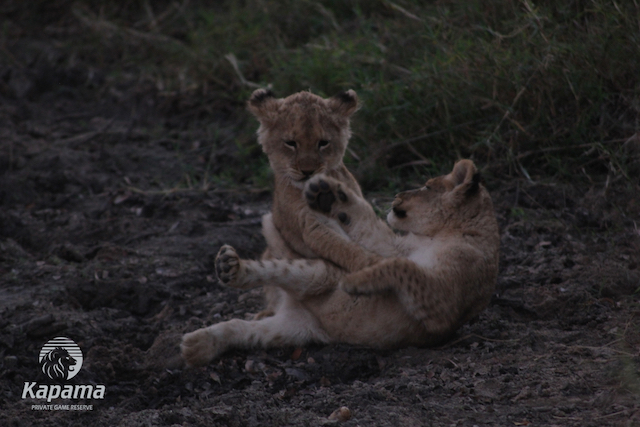
Some movement to the right of us caught my eye and out pounced two very young and energetic lion cubs. They looked to be around three months old and still quite spotted. This is a camouflage method nature has blessed them with, while they are still small and vulnerable to help them survive the perils of the bush.
They seemed to be in an incredibly playful mood and gave us a great show.
One ran towards her mother whose head popped up for a second as the cub landed playfully on her belly. The mom gave a small growl as the already sharp claws of her cub must have poked her slightly.
The cub then raced back towards her sister who was hiding behind a patch of dry grass patiently imitating her mother in the stalking position. Her sister neared her hiding spot. You could see the other cub’s excitement building up. She eventually couldn’t wait any longer and pounced playfully onto her sibling.

It was obvious that this was practice for one day when they will need to start hunting for themselves. Each of the young lion cub’s instinctively went for the neck of the other. It truly was great amusement, viewing these playful practice sessions of little hunters in the making.
The two eager bundles of furred energy made their way down to the muddy edge of the dam. Just like children. The dirtier, the better. We could see that perhaps rhinos or some other large herbivore had previously been wallowing in the mud and this was an ideal playground for curious adventurous little lions.
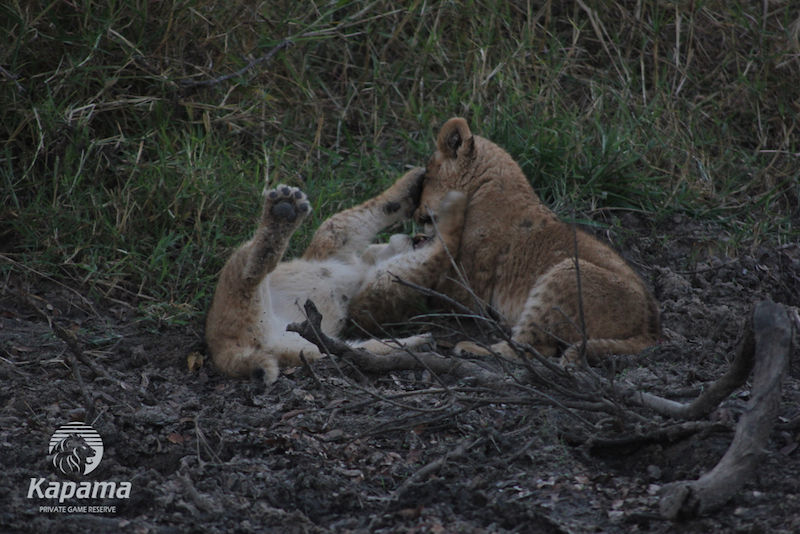
The cubs took turns tackling one another in the muddy mess with young growling sounds coming from them getting cuter and cuter as their play progressed.
We had been watching this scene for some time and did not notice the sun had already dropped down behind the mountains. It was nearing the time where other predators would be stretching and yawning, about to begin yet another evening.

The mother lioness slowly got up and ushered her cubs to a dense section of bushes behind the dam wall. Soon enough all became quite silent and the cub growls died down, possibly signally that they had dozed off after a very fun filled afternoon of playful practice pouncing.
Story and photos by:
Monika Malewski
Latest news
No Results Found
The page you requested could not be found. Try refining your search, or use the navigation above to locate the post.