
Safari Tracking – Quick Links
- Safari Tracking – An Introduction
- Tracking Wildlife – The Key Elements
- Tracking Wildlife – Core Skills Of A Tracker
- Tracking Wildlife – The Importance Of Trackers
- Tracking Wildlife – The Importance Of Tracking
- Tracking Wildlife – FAQS
- Safari Tracking – Every Track Tells A Story
Safari Tracking – An Introduction

“The ground is a book, and the tracks are its words.”
An inspiring saying often used by indigenous trackers, this phrase describes the art of tracking to perfection. Upon second read, it reveals something more: It explains what every safari experience should be about. Immersing yourself fully in the bush is about discovering that a story lies beneath every rock, and a folktale is alive in every living creature. There is far more to this experience than taking snaps of the famed Big Five.
This is why tracking is so significant. It tells the story of the African bush, immediately elevating the game drive or guided bush walk to a deeply captivating and personal experience. Read on as Kapama, a luxury private game lodge, details the key elements of tracking and why it matters as much as it does.
Tracking Wildlife – The Key Elements
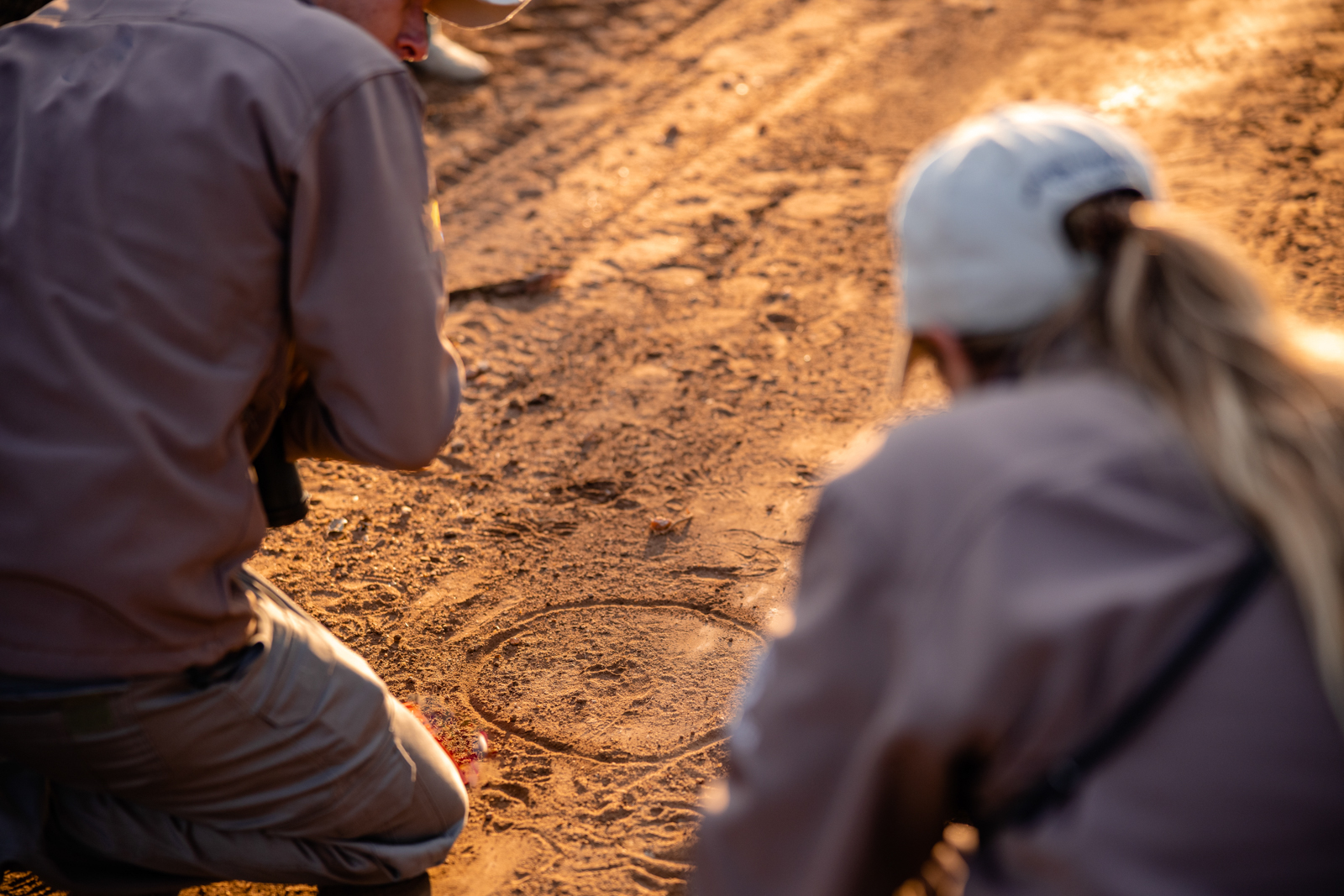
Wildlife tracking, interestingly, involves so much more than footprints (spoor tracking). There is also the study of scat, broken branches, vocalisations, and urine markings. All of these elements are vital when it comes to interpreting animal behaviour and their movements in the environment. Your highly trained Kapama guide will be able to successfully trace an animal’s recent path with this information, and possibly even predict its next thrilling move.
Spoor identification is the most well-known amongst the several mentioned. It is the study of tracks imprinted in soil, mud, or sand. The information derived here will reveal the identity, age, and even the sex of the animal. Flattened grass, broken spiderwebs, and food remains are more subtle signs. Read with care, they will be able to tell you more about the animal’s recent path.
The most interesting element lies with the auditory and scent clues. Listen closely to the calls of the birds and the various alarm sounds from prey. They are bound to alert you to the signs of a predator’s presence. Let’s have a look at the skills that a Kapama guide is required to have to successfully identify the wildlife found at our reserve.
Tracking Wildlife – Core Skills Of A Tracker/ An Assistant Guide

Of paramount importance is patience and observation. Your assistant guide requires stillness, silence, and an incredibly sharp eye for details to ensure that they are able to spot tiny elements that may be overlooked. Their movement, similarly, is slow, quiet, and deliberate. They are also bound to stay downwind so as not to alert animals to their scent.
Your assistant guide’s experience and local wildlife knowledge also come into play. These are especially useful when a trail goes “cold”. They will draw from their well of experience to anticipate the animal’s next decision to pick up the trail again.
Tracking Wildlife – The Importance Of Trackers

It is far too easy to dismiss the role of an assistant guide as that of solely tracking wildlife. The ability to, quite literally, take guests off the beaten track to find elusive animals adds incredible value to the safari experience. Furthermore, they give back to game lodges such as Kapama by monitoring and collecting invaluable data about several species (especially those that are vulnerable).
Perhaps the most important reason for assistance guides is this: They are the custodians of our wildlife stories. The faint claw marks on a tree and the musky scent lingering in the air? You’re in leopard territory. The tiny tracks in the soil? You may just be bearing witness to the meticulous path of the famous dung beetle. The stories carried by trackers ensure that knowledge such as this is never forgotten.
Tracking Wildlife – The Importance Of Tracking

While tracking has the potential to elevate a simple game drive to an interactive adventure, the art is also vital in a very practical sense. It assists with population monitoring and even anti-poaching efforts. The correct interpretation of wildlife signs will help conservationists take swift and timely action to protect vulnerable species.
It also contributes to a matter immensely close to Kapama Private Game Reserve: Sustainable tourism. As one of the finest examples of eco-tourism, it shifts the focus subtly away from “trophy sightings” to storytelling and authentic bush experiences.
Tracking Wildlife – FAQS
Is it possible to track wildlife?
Absolutely. With the assistance of GPS tracking, scientists are able to locate where an animal is and where it is going.
Are there benefits to tracking wildlife?
Animal tracking has several benefits. The information collected from this practice helps with the understanding of animal behaviours. Conservationists, in turn, can use this information to assist with anti-poaching efforts.
Are there any animals that are great at tracking?
Indeed, there are. Dogs such as the Bloodhound, Basset Hound, and even the Beagle are excellent at tracking animals.
Safari Tracking – Every Track Tells A Story

The Springbok, the national animal of South Africa, is famous for a unique behaviour called “stotting”. It describes a high, stiff-legged leap that is performed when the animal is fleeing predators. How can a tracker tell when a springbok has possibly been pursued? Its hoofprints are deep and clustered in comparison to regular walking tracks. Although the springbok flourishes in the Cape region and cannot be found at Kapama, its tracks are of great significance. They not only tell us about an interesting aspect of the animal, but send a message to the carnivore stalking it, too. It is a sign that the antelope is fit and difficult to catch, and not a likely meal.
And therein lies the magic of tracking. Every track tells a story. Stories of interesting animal behaviour, of indigenous knowledge, and ancient survival skills. A story well worth telling to anyone interested in an authentic safari experience.
Contact our team at Kapama Private Game Reserve for more information about tracking and booking your next adventure today.


