Stings and Talons
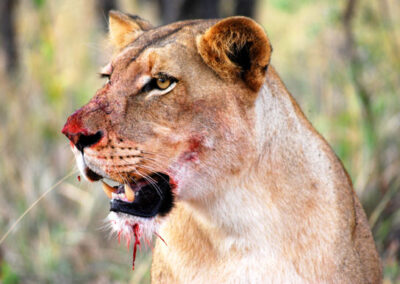
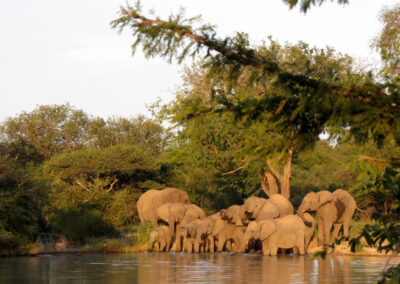
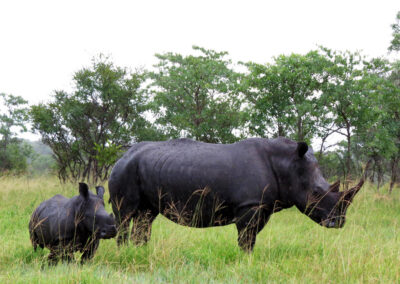
At Kapama, we concentrate on all aspects of nature, not just your much requested and sought after sightings of the Big 5. Yes, the lion, rhino, elephant, buffalo and leopard are wonderful to see out on a drive. For most guests, that is priority and for good reason. Seeing these animals out in the wild and in their natural habitat is a wonderful thing to experience. However, some of the most interesting things in the African bush are not as obvious. Some creatures are quite small, even tiny, or nocturnal so quite often may well be overlooked. That is where the experience, passion and love for nature of our rangers and trackers come into play.
Two of our rangers give us a unique insight, as well as a personal experience on a few of nature’s gems. They take us through the uncommon to explain the role they play in nature’s circle of life.
Spider Catching wasp, by Chris Reiner
Insects play a huge part in keeping the bush alive and thriving. Some pollinate, while others decompose.
All ants, bees and wasps belong to the sub order Apocita in the order Hymenoptera. One of the most intriguing for me is the spider catching wasp, which is classified under the family Pompilidae . The females are generally larger than the males with the largest species reaching a size of up to 50 mm in length. The smallest can be as small as only 10mm in size. Even something so small has its place in the ecosystem.
One common characteristic of the spider hunting wasps is that they all immobilize their prey (spider) with a paralyzing sting (normally the female wasp). Once subdued they drag or carry the spider into a crevice, pre-dug hole or nest chamber, where the egg is deposited on the living immobilized corpse before the spider is covered or sealed in it.
The wasp egg hatches in and around 10 days where the larva feeds on the spider until fully developed. At this stage the larva will spin a dense cocoon around itself, then lie dormant for several months until climatic conditions and humidity stimulate pupation. After around three weeks the adult emerges to continue the cycle. Something so small definitely has its place in nature.
What is the effect on humans? It is one of the most painful stings off all insects’bites, causing bad headaches.
I was fortunate enough to capture some terrific photos. Even when I am out on a game drive and my guests are eager to see the Big 5, I make a point of stopping and give them the opportunity to admire natures small wonders. In that way they can get a full bush experience and appreciate all that nature has to offer.

Birds of a feather- Collen Maenetja
Not too long ago, I took a family of eight guests out on a morning game drive. They were only interested in spotting the Big 5, which is normal for International visitors. With Kapama Game Reserve being in the Greater Kruger area and spanning close to 15,000 hectares, spotting all of the big 5 within two game drives during a stay, is quite possible.
It turned out to be a fantastic morning. Not only did we see two rhinos, but we were fortunate enough to come across a big herd of buffalos at the same place. Not long after, we witnessed two male giraffe making their way to this seemingly popular spot. Their fighting was soon interrupted by the buffalo who frightened them away. The guests were elated that they were able to see so much. On our way back to the lodge we spotted something that for me was something quite special.
As we took a corner I spotted a giant eagle-owl.

It is Africa’s largest eagle owl and one of the most impressive birds of prey. This particular owl was perched in one of the biggest trees in Kapama, called the jackal berry tree. Not only was it a rare sighting, as they are nocturnal predators, but it appeared that it had made a kill. Normally they feed on fish, rodents or other large birds. Its chosen prey for today was a guinea fowl. This predator hunts from its perch and uses its expert eyesight to spot its prey. Once the prey has been spotted, with silence and agility, it glides towards the ground and prey, seizing it in its talons. By looking at all the scattered feathers and remains of the guinea fowl, it would appear that this is exactly what the giant eagle-owl had done.
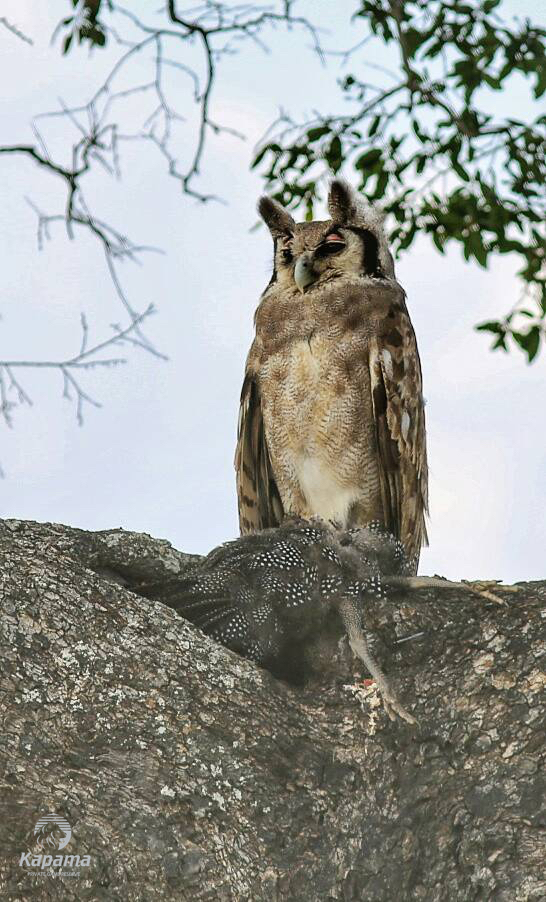
So often the uncommon animals in nature gets forgotten or overlooked. Perhaps they are well camouflaged, or they are too low on the ground or too high up in a tree to make a significant impact or impression on most guests. I was very pleased to see the reaction of the family of 8, on this unique sighting and their interest in learning more about the interesting bird of prey. They took just as many pictures of the giant eagle-owl as they did of the earlier animals. On the way back to camp, the giant eagle-owl sighting was certainly a huge highlight of their game drive.
Stories and photos by:
Chris Reiner & Collen Maenetja
Latest news
No Results Found
The page you requested could not be found. Try refining your search, or use the navigation above to locate the post.