Tree Agama
As we begin to move into Spring, the bushveld and trees are now beginning to sprout vibrant green leaves again. The flowers are showing off their beautiful colour palet in contrast to winter’s dull browns and greys. Insects seem to be appearing as if out of nowhere. However with nature’s story and the circle of life, along with the insects also comes the creatures that feed on them.
It was a beautiful clear morning. We set out from Kapama’s Buffalo camp for our morning drive. We found a beautiful spot next to a small dam with magnificent views of the Drakensberg mountains. I decided to park in the shade of a huge Red Thorn where we packed out our table, and decked it with a white tablecloth and French press, only to be accompanied with the best coffee and homemade cookies. My guests hopped out the game viewer and breathed in the crisp fresh morning air, while we enjoyed our second cup of coffee of the morning.
While sipping our steaming coffee one of my guests came running over to me and quickly dragged me over to the tree on which they had seen this
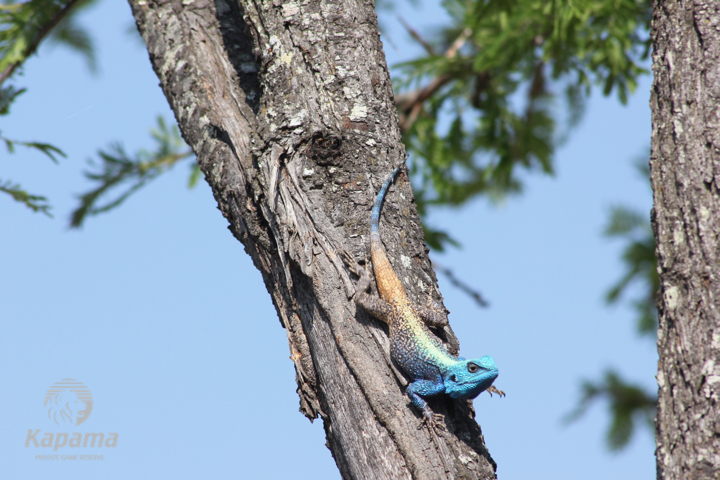
Amazing lizard with a blue head!
I identified it as a southern tree agama or blue-throated agama. In the past, agamas lived in the forests of Africa. When forests began to disappear, they managed to adapt to a life in open spaces, like the wilderness and bushveld of the Greater Kruger.

What’s amazing is that the males will enhance and brighten their blue colour while breeding to attract females. With agamas, their dominance in the group is determined through fights. A dominant male is brightly colored and this male enjoys the privileges of mating with females and also gets the best place to rest.
During mating, they bob their head up and down in a display. While admiring the agama, another caught my eye. Lower down on the same tree I spotted the female tree agama. Her markings were strikingly different and superbly suited to their tree-dwelling habitat. Being perfectly camouflaged against the bark of the branch, she too bobbed her head up and down towards the male.

The agamas lay a clutch of about 8 to 15 eggs mid-summer and it takes about 2 months for them to hatch so I’m sure these two were having a bit of a flirt, getting ready for the silly season. The Agama usually eats ants, crickets, caterpillars, worms, and spiders, however, they have also been known to eat seeds, berries, fruits and eggs of other lizards and birds. Agama can survive for a long period of time in the wild. An amazing fact is that their average lifespan is between 25 and 28 years.
The blue-throated agama is not poisonous but beware, as they will still deliver a painful bite. Your warning will be the bright orange mouth lining while they gape their mouth open.
Only having ever seen them on trees I was surprised when the male very quickly jumped from branch to branch and made his way down to the grass below, stopping only for a second to glance around for predators. And just like that, he was gone. A beautiful flash of blue reminding us of the great diversity of the African bushveld.

Story and photos by:
Ranger Monika Malewski – Buffalo Camp
Latest news
No Results Found
The page you requested could not be found. Try refining your search, or use the navigation above to locate the post.