
An unexpected visitor
Recently we have been extremely lucky to have a pack of wild dogs join us on Kapama Private Game Reserve. The African Wild Dog, or “painted dog” is listed as endangered on the IUCN RED LIST and is the second most endangered mammal in Africa. With home ranges of up to 1000 square km and almost always on the move, together with numbers thought to be less than 5000 and not even 300 in the Kruger area, you can imagine the excitement amongst the rangers.
The first time I heard them being called in, I was very confused. When rangers talk about animals over the radio, we use the local Shangaan names for the animals. I heard them call the wild dogs by their Shangaan name, I had to ask my tracker Godsave, what was being called in, as it was a first for me. Once I knew what the species was, my heart rate and excitement skyrocketed.
The ranger that had spotted them earlier said it looked like they were ready to be on the move again. Now just keep in mind that when wild dogs are on the move, they can travel incredible distances in a short period. So, I knew that keeping up with them would be extremely difficult. But with hopes still high I made my approach.

Luckily, they decided to hang around the dam for a bit longer and as we arrived, we got to see them. I was so excited, and my excitement filtered through onto my guests. I had no words and couldn’t speak; my guests were very understanding because they realised how special it was to be a part of this pack’s morning activities. You realise something is truly special when your ranger is at a loss for words and takes out their camera to capture the moment.
We sat for a while just observing their behaviour and what they were doing. What made this even more special, was not just a pack of wild dogs, but we could see young pups with them as well.
The pups were having an absolute blast of a time trying to pull a stick out from the water, they eventually got it right and proceeded to play with it, just like most dogs would.

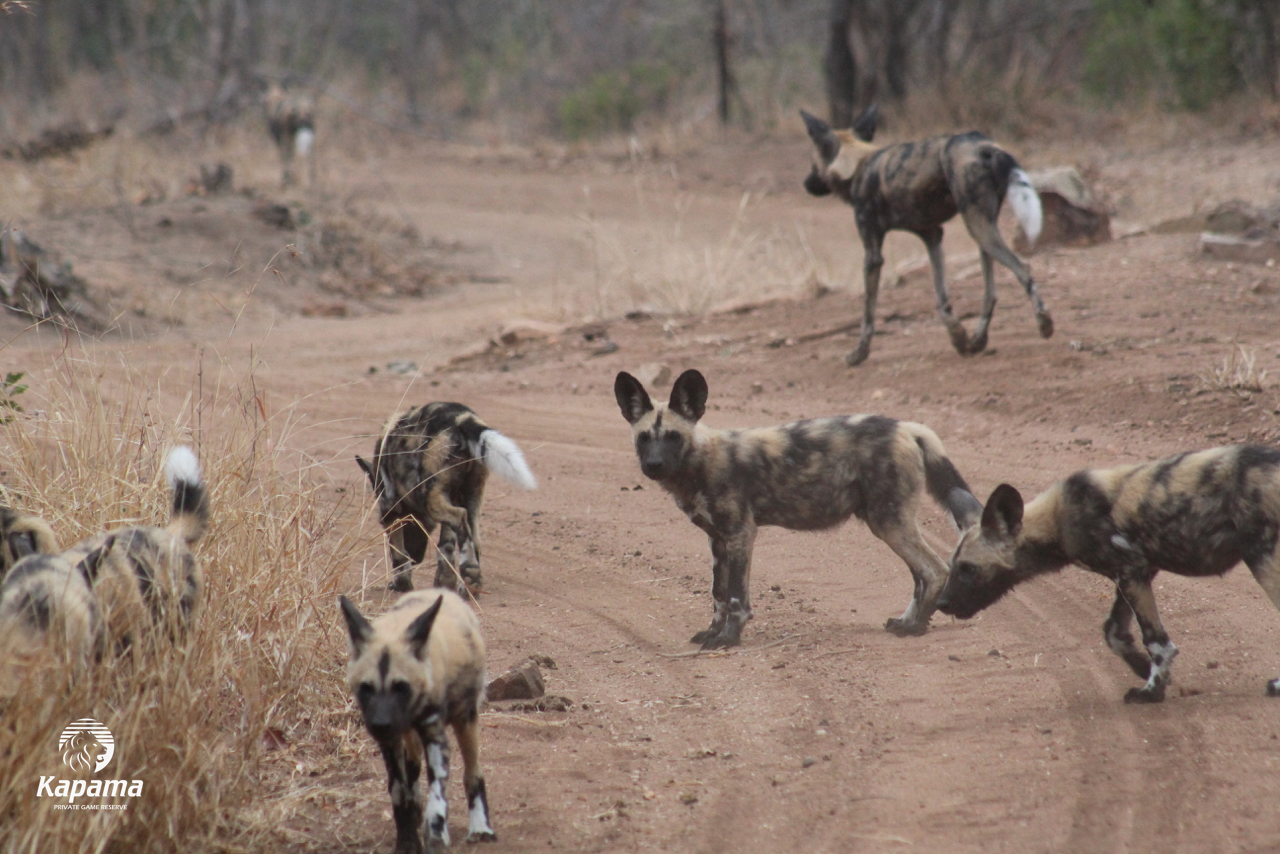
While the adults just ran around sniffing the ground and making sure the pups were well behaved. After a while, I managed to regain composure and could then explain a bit about these incredible animals to my guests.
– Pups are born in a den and remain there for the first 3 months
– All pack members help take care of the pups
– Wild dogs are regarded as one of the most successful hunters with a success rate of over 80%
– As they have so much stamina, they chase their prey over large distances tiring them out
– The weakest fall behind and become prey
– Females are generally bigger than males
– The coloured pattern of each dog is unique and is used for individual identification
– They lack dewclaws on the front legs, unlike other canid species

After admiring them for a while suddenly the adult individuals ran towards the pups and they were all interacting with each other by rubbing themselves against one another. That happened for a brief moment and they all got up and ran off into the distance.
We tried to follow them but like I mentioned before, they can travel long distances in a short period, so it was difficult to keep visual. They then disappeared into the bush, but we got to be a part of their morning routine, even if it was only for a short time.
Story and photos by River Lodge Ranger Brian Dann & Tracker Godsave
Latest news
No Results Found
The page you requested could not be found. Try refining your search, or use the navigation above to locate the post.