The Porcupine
Porcupine is one of the most interesting night animals to come across while out in the bush. Although, we don`t get to see them for very long as their first instinct is to dart out of sight. Many people are aware that the Porcupine is a mammal, but little know that is part of the rodent family, such as beavers, rats and mice.
The Porcupine is the largest rodent in Southern Africa and is the prickliest of all the rodents. Its scientific name refers to “Quill pig.” There are more than 24 different species of Porcupines across the world, and they all have needle-like quills. The purpose of these quills is to give their enemy a fair warning that they are no easy meal.

There is an African Myth that says that the Porcupine can shoot its quills at its enemy. This is not true, but the quills do easily detach when touched. The quills are modified hair and can be regrown once they are lost. The quill itself has a very sharp tip with overlapping scales which makes it very difficult to remove when they are stuck in an animal’s skin. A single porcupine can have up to 30,000 quills! Some quills are as long as 50 cm.
They can weigh between 18 and 30 kg and reach a length of 90 cm. Now that is a very big rodent! Porcupines are active at night spend this time foraging for food. They are mostly vegetarian, using their strong sharp claws to get to roots. Their diet also exists of bulbs, fallen fruit such as the Marula, and will sometime gnaw on the bark of the Tamboti Tree. The debarking of the trees plays an important role in the ecosystem, preventing the development of a denser environment.
They use their strong claws to dig a burrow which they will utilize to sleep in during the day. The digging of the burrow is vitally important, not only does it provide shelter for the animal to sleep in, but the digging of the burrow forms the shelter for other animals like the Warthog. Because the warthog has no claws it is not able to dig the burrow, so they rely on the Porcupine to dig the burrow for them. With warthog being a diurnal animal and the Porcupine being a nocturnal animal, these animals often share the “apartment”, and as the sun rises or sets the other housemate moves out and starts their day.
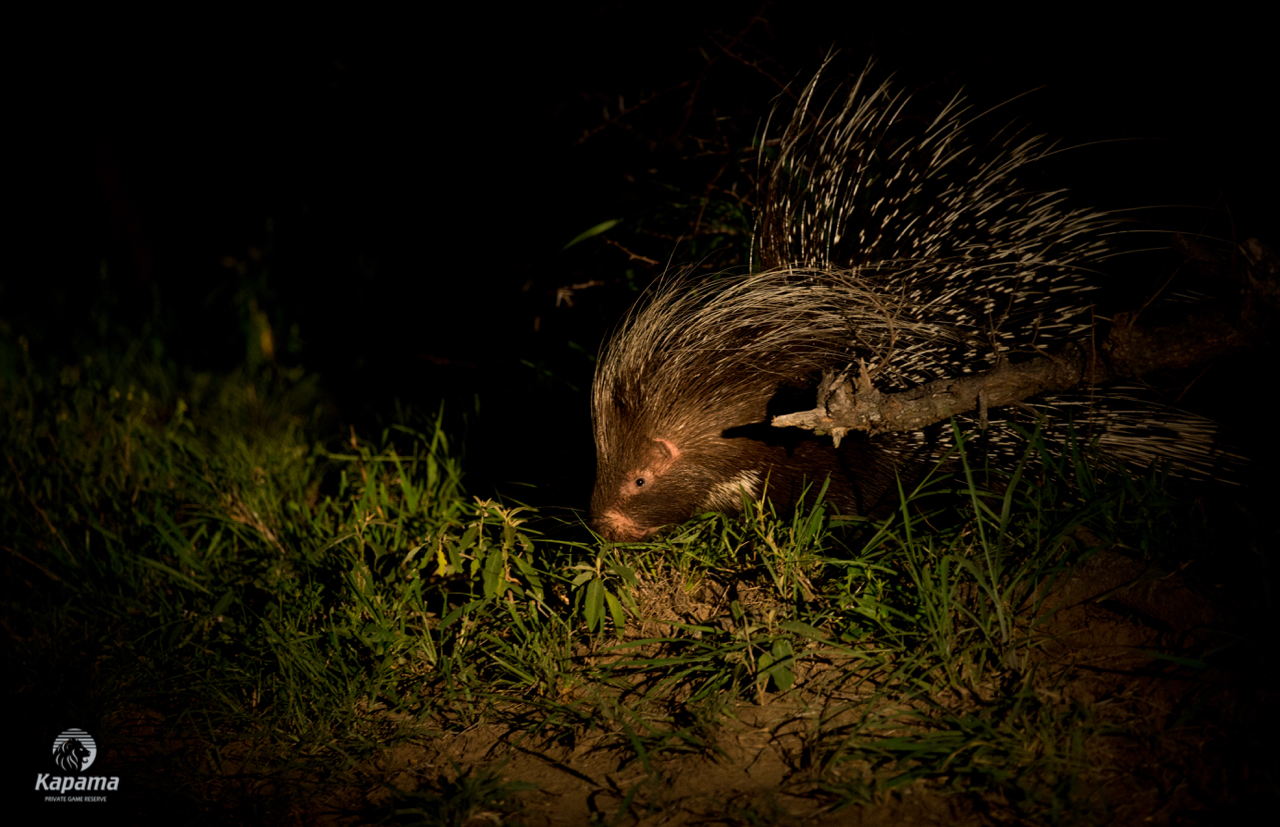
At River Lodge, there is a resident Porcupine that often comes around to the “BOMA” area during dinner time. One evening when my guests and I were having dinner we heard a rustle in the bushes…What might that be?
I got up to investigate and came across this quilled fella! We could see how long some of the quills were and how relaxed it was with our presence. After getting some photos of him he decided that his visit has come to an end and that it was time to go and look for some food somewhere else.
Story by: River Lodge Ranger – Lisa-Mari Lutze
Latest news
No Results Found
The page you requested could not be found. Try refining your search, or use the navigation above to locate the post.